
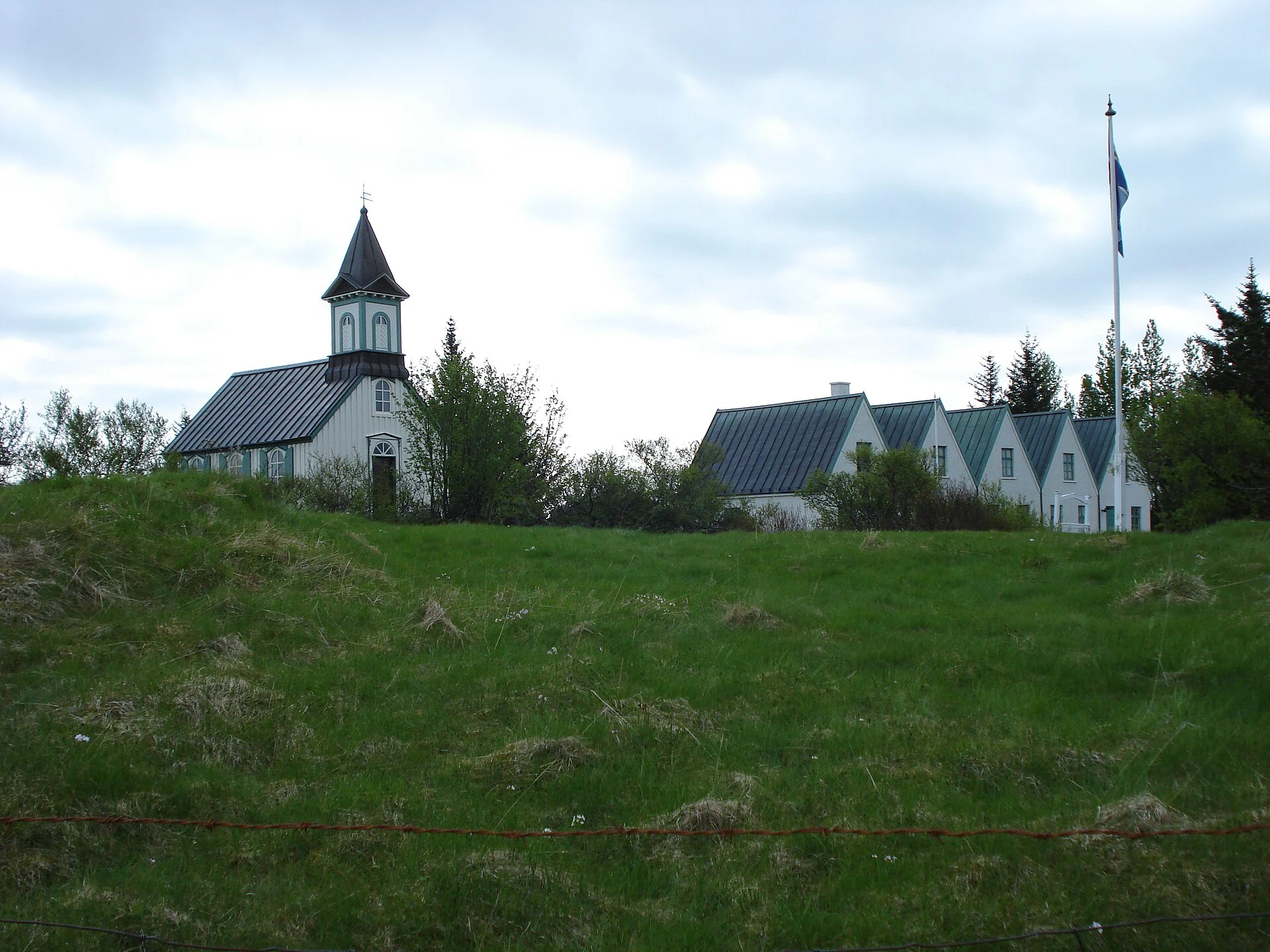
Thingvellir Church: History and Visiting Access
Find Þingvallakirkja, understand the present building and check ranger-dependent summer entry before planning an interior visit.
Church access reference
Plan the exterior independently of church entry. The park gives usual summer periods, subject to ranger presence. Winter entry is tied to irregular services. Recheck before travel.
Visit options and their limits
Visit: Exterior
- Published access
- Part of the old assembly-area visit
- Limit
- Follow the current paths and signs
Visit: Summer interior
- Published access
- 1 June to 31 August; usual 09:00-10:00 and 13:30-17:00
- Limit
- Requires a park ranger to be present
Visit: Winter interior
- Published access
- Closed except for irregular services
- Limit
- A service is not a normal sightseeing session
Þingvellir National Park, Þingvallakirkja · · © thingvellirnationalpark.com.
Thingvellir church, known in Icelandic as Þingvallakirkja, stands within the old meeting area. The white building makes a useful stop on a history walk. It is not a church left intact from the first Alþing. The present building dates to 1859. Entry is a distinct question from seeing its exterior.
Plan an exterior visit as part of the signed old meeting area route. For entry, the park publishes summer access from June through August, dependent on a ranger being present. Winter access is tied to irregular services. The present church belongs to a long tradition at the site, but it is a later building. Check the official page before making its interior the fixed point of your day.
Last fact checked: 14 October 2026. Seasonal access can change; use the linked official source before travel.
Where Thingvellir church sits
Þingvallakirkja is within the old meeting area, near the river and the adjacent houses. The park's church page names it as part of that setting. Use the official visitor map and signs to approach it. The church is one stop among the meeting grounds, not the whole historic site.
The parking service details names P5 at Valhöll as the lot nearest the church and Silfra. That does not mean a Silfra meeting starts at the church or that the church provides activity check-in. A water booking has its own instructions. Keep the two places distinct when using a route app.
You can also reach the church as part of a longer old meeting area walk if the route is open and suits you. Check the path rather than choosing by straight-line distance. A map pin does not describe slopes or ice, nor the best entrance for your needs.
When asking for directions, use Þingvallakirkja or “the church at Þingvellir.” “Visitor centre” means a different building at Hakið. “Service centre” means Leirar. Those names are useful, but none is a substitute for the church's actual location.
Thingvellir church history and the present building
The park dates the latest building to 1859 and the addition of its bell tower to 1907. It is the latest church in a longer sequence at the site. This history links to a decision at the Alþing in 1000. Iceland adopted Christianity that year.
The park's Christianity account sets out the decision and the church tradition that followed. It refers to churches at the meeting area from 1017, while distinguishing the present building. Keep the dates attached to the right thing: the adoption of the faith, the earlier church tradition and today's structure are distinct events.
The source also connects church use with the assembly. It says the council could meet inside during poor weather under the earlier legal code. That gives the church a useful link to the outdoor gathering, beyond being a nearby place of worship.
Do not describe the present building as the room in which the first assembly met. The Alþing began outdoors long before this church was built. Read the Althing guide if you want to place the church among the other historic features.
Details you may notice inside
The official history page sets out a pulpit and altarpieces, as well as bells from different dates. These belong to the church's longer use. They are not all the same age as its walls. If the building is open, read the account before attaching a date to an object.
The interior is a place of worship as well as a visitor stop. Follow any local request about taking photos, movement or silence. Do not assume that an open door allows unrestricted filming, or that an object may be moved for a closer view.
Exterior and interior access are different plans
The church exterior can be part of an old meeting area walk without the interior being open. This makes it easier to plan a visit that still works if entry is closed. You can read the building's date and its place in the site while viewing it from the allowed approach.
Interior access depends on the park's plans. Listed hours are not a promise of an open door. Check the latest access before you arrive. Staff dates and services matter. If you need entry for a particular purpose, ask the park directly before travelling.
The park's checked church page says summer entry is available when a ranger is present. It gives usual morning and afternoon hours, with a gap between them. That gap is a reason to check the full source rather than seeing “summer” and assuming all-day access.
For a group, match the visit to its needs. Someone may want a quiet interior stop, while others want a short exterior photo. Decide which of those is essential. If the answer is the interior, leave spare time and have another old meeting area stop ready for a closed door.
Seasonal openings and church services
As checked in October 2026, the official church page states an opening season of 1 June to 31 August, subject to a ranger being present. It sets out usual hours of 09:00 to 10:00 and 13:30 to 17:00. These are the source's usual times, not an appointment or a promise for a particular day.
The same page says the church is closed in winter except for services held at irregular times. Do not treat winter services as ordinary sightseeing sessions. If your trip falls outside summer, plan to see the exterior and check directly if a service or exact access matters.
For church-related questions, the park page gives the park's contact route and names the priest's connection with Skálholt. Use the latest contact details at the source. A tour operator may bring you to the area, but it cannot make an unscheduled church opening part of the visit by implication.
Check whether your tour's stop is a general park walk or specifically includes church entry. A phrase such as “historic Þingvellir” does not tell you that. Read the route and ask what happens if the church is closed. Our Thingvellir tours comparison explains what to check about park time and transport.
Combine nearby history without rushing it
The church fits well with an Althing account walk. Keep the sequence clear: outdoor assembly, later church tradition, present building. Nearby booth remains add evidence of how people stayed during the gathering. The church helps you see continued use of the place over time.
The drowning pool is another historic stop, but it belongs to later legal practice. It should not be presented as part of a single undated “Viking village.” The site contains several periods, and their distinctions are worth preserving.
For the terrain around the walk, use the tectonic plates guide. The natural process explains faults and sinking ground, not the age of the church. A view of the building below rock walls can contain both stories without making one a cause of the other.
If you want to stay nearby, compare hotel bases by road access and your next day's plans. Do not choose a hotel purely because a search page lists the church among its nearby attractions. Confirm the route, arrival time and meals as distinct parts of the stay.
A church-visit checklist
- Before travel: check the official church page for summer access and any latest notice.
- For interior entry: note that usual hours depend on a ranger being present.
- For directions: use the church's Icelandic name and the park's latest visitor map.
- At the door: follow requests about worship, taking photos and quiet.
- If closed: use the allowed exterior view, then continue to another signed historic stop.
- For a booked tour: ask whether it includes entry or only time in the surrounding park.
Leave paths and doors clear for others. A group photo should not block the entrance. Keep the grounds tidy and avoid stepping onto nearby historic remains while trying to frame the building.
Frequently asked questions
How old is the present church?
The park dates the latest church to 1859, with its bell tower added in 1907. Earlier churches stood in the meeting area long before it. Attach the nineteenth-century date to the building you see today. The start of the church tradition and the adoption of Christianity are distinct parts of the story.
Is the church open in winter?
The park says it is closed in winter except for services held at irregular times. That does not provide a normal winter sightseeing timetable. Plan an exterior visit unless you have checked an exact plan. A service is a worship event, so follow its rules rather than treating it as general visitor access.
Can you rely on summer opening hours?
The official page gives usual summer periods but makes access dependent on a ranger being present. Check the source near your visit, and avoid building a tight route around an assumed open door. If entry is essential, contact the park. An exterior stop provides a useful alternative within the same setting.
Is the church the old parliament building?
No. The early Alþing was an outdoor assembly. The church tradition connects with later religious and assembly practice, but the present building is much newer than the founding of the Alþing. Read the assembly signs alongside the church history, so the different functions and periods stay clear during your walk.
Verdict on visiting Thingvellir church
Thingvellir church works best as a history stop within a wider old meeting area walk. Plan the exterior first, then check whether seasonal entry fits your date. Keep the present building's age distinct from the older church tradition. Return to the park overview to match the stop with transport and the rest of your visit.
