
Silfra Diving: Requirements and Planning
Check Silfra scuba qualifications, dry-suit proof and depth rules. Plan operator forms, equipment, transport and the whole visit before booking.
Diving proof has separate parts
A scuba qualification, dry-suit background and operator-specific checks are distinct. The park permits a written recent-dive alternative to dry-suit certification under its stated conditions. This record is not guest approval.
Diving proof has separate parts
Task: Scuba qualification
- Checked park rule
- Equivalent to autonomous diver
- Practical check
- Have the actual supplier check the card and issuing body
Task: Dry-suit background
- Checked park rule
- Dry-suit certificate or stated alternative proof
- Practical check
- Do not assume a general scuba card answers this
Task: Alternative proof
- Checked park rule
- 10 registered dry-suit dives in the last 2 years, with stated instructor confirmation
- Practical check
- Check records and dates against the actual tour
Task: Other conditions
- Checked park rule
- Suitable full cold-water gear, buddy and open-area rules
- Practical check
- Read the chosen operator forms and gear requirements too
Park rules and named operator product pages; links in article · · © thingvellirnationalpark.com.

Silfra diving requires scuba training and dry-suit proof before the scenery enters the choice. The park requires an autonomous-diver qualification, plus dry-suit certification or its stated recent-dive evidence. A standard Silfra dive is not a first scuba lesson. Check the actual operator's documents and gear limits before building the day around it.
TL;DR: Have the required scuba card and dry-suit proof checked by the booked supplier. Read its form and fit chart too. The park's maximum diving depth is eighteen metres, with no caves or overhead areas. Plan the full visit, including arrival and changing.
Last fact checked: 14 October 2026. The park is the source for site rules. DIVE.IS and Arctic provide named product examples. This guide does not teach diving skills or decide a guest's medical eligibility.
What the Silfra diving experience involves
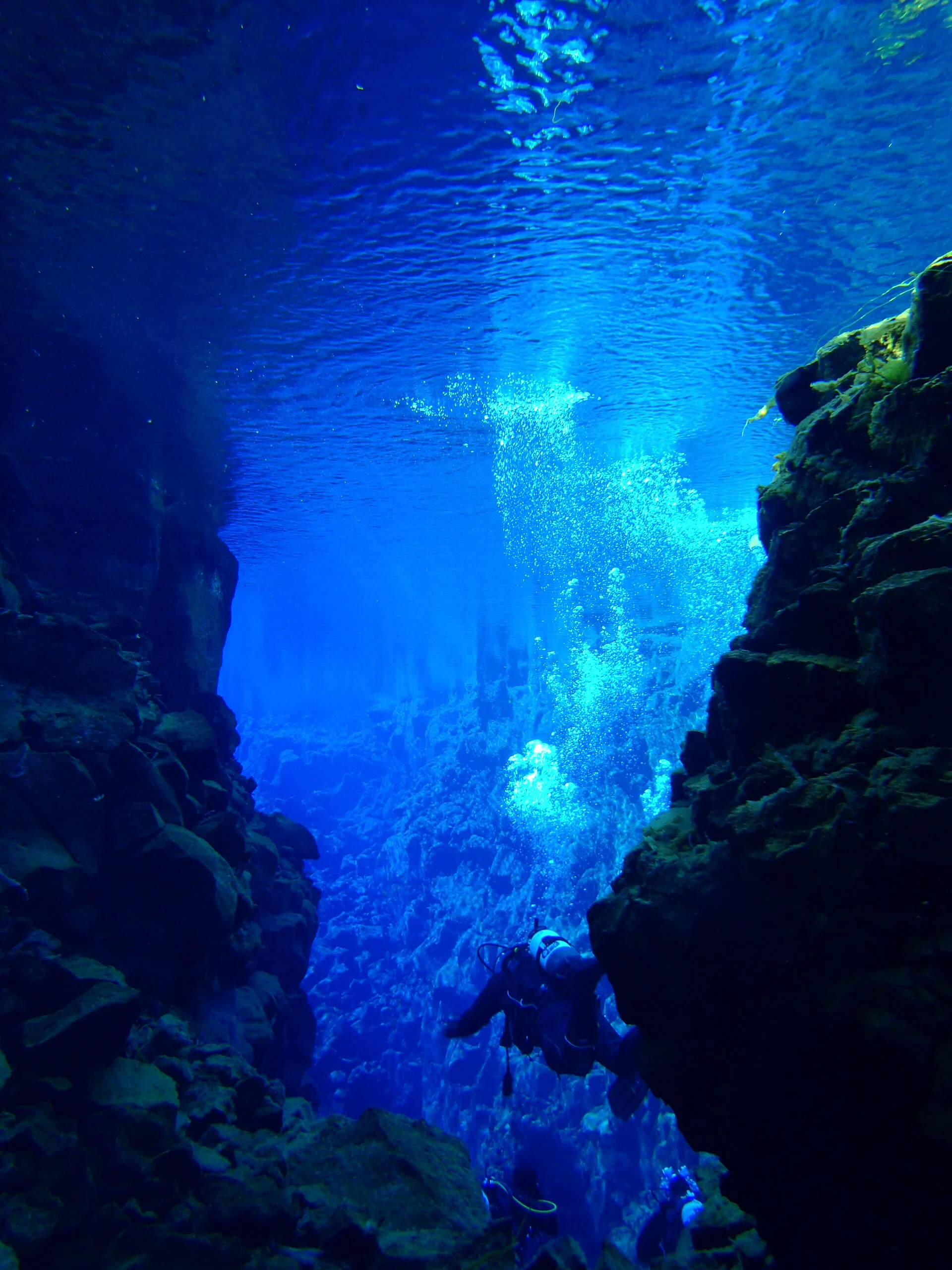
Silfra is a water-filled fissure in Þingvellir's rift landscape. Its clear water gives a view of submerged rock. Scuba places a trained guest below the surface within the allowed route. Snorkeling is a separate surface activity, with different equipment and booking conditions.
The water view is only part of the site. Read the park's Silfra account for its geological setting. The familiar phrase “between the continents” simplifies that setting. The park's local account names a smaller crustal block as well. A tour slogan cannot replace that source.
Our tectonic plates guide separates the wider rift system from local faults. A dive can show rock close up, but it does not map a whole plate boundary. You can also read the geology from land. A water booking is one way to visit the place, rather than a requirement to understand it.
A guided dive starts with check-in. The briefing is another part of the visit. The operator fits gear and manages the activity route.
There are walks before entry and after exit. Changing and collecting belongings take time too. Do not reduce the plan to the minutes under water.
Current Silfra diving certification requirements
The official park rules state two parts of the scuba requirement. One is a qualification equivalent to an autonomous diver. The other is dry-suit certification or accepted proof of recent dry-suit dives. Both parts need attention.
For the alternative proof, the park names ten registered dry-suit dives within the last two years. It requires written confirmation by an instructor affiliated with a recognised diving organisation. A personal statement that you have done the dives is not the listed proof.
DIVE.IS's Silfra diving day tour names Open Water Diver or equivalent for its product. It also sets out dry-suit proof. Use its exact document instructions if that is the product you choose. Do not infer acceptance from a broadly similar card name.
Ask the actual operator to check any uncertain equivalence. Give it the name of the qualification and the issuing body. Do that before the trip, while you can obtain a missing record or change your plan. A calendar accepting payment does not mean someone has checked the documents.
The reference record above keeps the qualification tasks separate. It is a planning checklist based on the park's rules. It is not proof that a person who ticks the list is accepted for a dive. The supplier must review the actual records and its own conditions.
Prepare the dry-suit proof early
If you hold a dry-suit certificate, find the record requested by the booked operator. Check that you can open it and that the name matches the guest. Ask whether the supplier wants a copy before arrival as well as the card at check-in.
If you use the recent-dive route, read the operator's form for that proof. The park's rule includes both the number of dives and a recent time period. A long history of diving does not establish those specific points. The written confirmation must serve the rule you are using.
Check the dates against the tour date. Do not count a dive outside the stated period because it is easier to find. Ask the operator about any uncertainty in the record. It must explain how it applies its document process, rather than leave the guest to guess.
Have the required instructor confirmation arranged before travel. Do not assume the guide at Silfra can sign for training or dives they did not observe. The rule names a type of confirmation, not a courtesy available at a meeting point.
Keep the evidence with the booking. If you change the date, ask whether that changes the proof window or other conditions. A response for one product or departure may not settle a later booking. Make sure the records still match the actual plan.
If you do not yet meet the dive requirements
Do not treat the standard dive as a trial session. The required training and dry-suit proof are part of entry to that product. A guide's presence does not waive them. A private group is not a route around them either.
DIVE.IS describes a separate course-and-dive package on its current product page. A course enquiry has its own prerequisites and schedule. Ask the operator what background it requires for that package. Do not assume that adding a course name to the booking settles the full training task.
Allow for the whole course format if that is your enquiry. It is different from fitting one dive into a sightseeing day. Check where it starts, which documents are needed and what each day includes. The operator must explain how completion relates to the planned Silfra visit.
Snorkeling may be a separate choice for a guest without scuba proof. It still requires swimming ability and compliance with the supplier's conditions. Read the dive-or-snorkel comparison before assuming that a switch is simple or available on arrival.
A land visit is another option. The park overview can help build a walk around the assembly grounds or visible faults. It does not provide diving approval, but it can give the day a clear purpose without a water activity.
Park rules and the operator's product rules
The park sets site conditions. The supplier sets requirements for its service within them. Read both. Passing a park qualification rule does not remove an operator's size chart, required form or age limit.
For example, the checked DIVE.IS scuba product gives a minimum age of seventeen. It requires a legal guardian's signature for a guest under eighteen. Arctic's activity overview describes eighteen as its diving minimum. These are different product conditions. Do not turn either into one universal supplier rule.
The operator's selected tour matters too. A course, private format and ordinary day tour can have different structures. Keep the product name beside each answer you receive. A general reply about “diving in Iceland” may not cover the exact booking.
If the booking is sold by a marketplace, identify who operates it. The merchant name and supplier can differ. Use the operating company's participation rules and the accepted booking terms together. A platform's broad attraction description does not replace them.
Forms and individual checks
The park notes medical screening for operator guests. DIVE.IS's scuba page links its diving statement and explains when further approval is required. Read the actual form early. This guide cannot decide whether a health condition permits participation.
Use the diving form for the booked product. A snorkeling statement or a document from a past dive elsewhere may not meet this supplier's process. Ask what it needs and where to submit it. Keep private health details within the named process.
DIVE.IS's checked product has an extra form requirement from age sixty. That is a supplier condition, not a diagnosis about older divers. Follow its stated procedure if it applies. Do not infer approval from being within a general age range.
Tell the supplier about an unresolved form question before travel. It may need time to explain the next step. The meeting point is a poor place to discover a missing document. Paying for transport does not resolve that omission.
Final fit and document checks remain with the operator. A booking confirmation does not guarantee acceptance if a condition has not been met. Ask how the terms handle that outcome before you attach other fixed bookings to the activity.
Depth and site orientation
The park's maximum permitted diving depth is eighteen metres. It also prohibits caves and other overhead environments. Read that as an upper limit, not a depth the product must reach. The guide controls the actual allowed activity plan.
Physical descriptions of the fissure can mention deeper areas. Those numbers describe terrain, not a visitor's permitted route. Do not compare products by the largest depth in a destination article. A deeper geological feature does not create an inclusion in your dive.
DIVE.IS's site account names Big Crack, Silfra Hall, Silfra Cathedral and Silfra Lagoon. They are parts of a described route. They are not separate places to enter without check-in or a way to navigate independently from this article.
The operator's Silfra site page describes designated entry and exit platforms. Use the guide's current instructions for them. A photo showing a person beside the water does not authorise a different entry.
This guide gives no instructions for depth control or equipment use. Those skills belong to the required training and the operator's briefing. Use the site names to understand the itinerary, then keep the activity within the staff's instructions and park rules.
Cold-water equipment
The park requires a dry suit for scuba divers and full suitable cold-water gear. Its snorkeling allowance for suitable thick wetsuits does not apply as a scuba alternative. Do not arrive expecting to use another suit type because a snorkeling article mentions one.
DIVE.IS's equipment account describes supplied gear and layers. It asks guests to bring comfortable warm base clothing and socks. Read the selected product's current list before packing.
A dry suit is designed to keep the body dry. Layers beneath it are part of the thermal system. Hood and gloves do not necessarily keep the head and hands dry in the same way. Do not treat the garment name as a complete-dryness or warmth guarantee.
Ask about bringing personal equipment before doing so. DIVE.IS's equipment page asks guests to use its provided gear. A diver's preferred setup may not be accepted for that product. Get the policy for the actual booking rather than assume permission.
Suit fit and movement on land
Use the supplier's exact size chart. DIVE.IS's checked product lists height and weight limits and also requires fit within its chart. Those broad figures do not certify a particular suit will work on a guest. Ask about a value near a boundary.
Tell the operator if tight gear is a concern. A dry suit can restrict movement, as its equipment page notes. That matters during fitting and the walk too. The supplier should explain the actual setup before you commit.
Think about the full route with equipment. Reaching the meeting area is not the whole access task. There is a walk toward entry and a return after exit. Ask about the task you need to complete, rather than a general claim that the site is accessible.
Raise a fit problem with the guide before entry. Do not use a web page to adjust unfamiliar seals or gear yourself. The operator must fit its system and give the briefing. This guide helps prepare the question, rather than perform the check.
Transport and meeting-point planning
Choose self-arrival or pickup explicitly. DIVE.IS describes both on its product page. The selected option controls whether transport is included. A general transfer paragraph does not make it part of every ticket.
For self-arrival, its directions put guest cars in P5. The meeting area is separate, and the nearby Silfra car park is for commercial vehicles. Our meeting-point guide links the supplier's separate maps for parking and check-in.
For pickup, check the named Reykjavík stop and time. It may differ from the accommodation entrance. Save the current arrival message. A changed booking needs matching instructions for the new option.
Check current road information for a drive and SafeTravel for travel notices. A broad road-time estimate cannot predict conditions on the date. If a problem affects arrival, contact the operator promptly.
Plan the full time commitment
Use the whole-visit estimate on the selected product, not only dive time. DIVE.IS lists a full site visit and separately describes time in water. Its page also gives a sequence covering check-in and fitting before entry. Those tasks are part of the booking.
Allow for the walk from guest parking before check-in. The product's early-arrival instruction is a deadline to meet, not free time for another attraction. Plan backward from that point. Being within the park does not mean you have reached your guide.
Keep the return and changing tasks in the plan. You may want spare clothes and a place to put wet items. Follow the supplier's packing instructions. Do not assume a quick finish because the water part sounded short.
If you add the assembly grounds, give that walk its own time. The Althing guide helps read the low remains and Law Rock area. A rushed photo stop does a different job from a history walk.
Buddy pairs and mixed parties
The park prohibits entering Silfra alone. A guided product also has its own group arrangement. Ask about staying with a particular buddy if that matters to you. A single group booking does not prove everyone shares one guide.
DIVE.IS's product describes a limit of three divers per guide. It notes that some larger parties can be split and describes another buddy format. Use the selected product's terms if you want to keep a pair together. Do not infer that arrangement from a total headcount.
A party with divers and snorkelers needs a separate timing check. They may use different guides and enter at different times. Ask about check-in and the expected finish for each group. Being at one site is not the same as doing one activity together.
For children or people waiting on land, ask what arrangements exist. Do not assume the operator supervises non-participants. If an adult must accompany a child on another activity, confirm that rule separately. A nearby dive may not meet it.
What is included and what may be extra
Read the selected product's list. DIVE.IS describes a guided dive, necessary gear and site admission on its checked page. Transfer depends on the arrival option. Tour photographs are described as a separate purchase. Confirm the current package before comparing totals.
Parking for your own car is another task. Use the park's parking page for the current lots and charges. Do not assume site admission in a dive ticket covers a guest vehicle's parking.
Extras can change the whole day. Another dive, a course or a souvenir is not implied by the ordinary product's name. Ask what the selected option covers and what must be booked separately. Avoid treating optional items as standard inclusions.
No dated price or rating is used here. The named product is an evidence example, not a personally tested recommendation. Compare the guest requirements and full package before deciding what it is worth to you.
Cancellation and booking questions
Read the accepted terms for the exact product. Your cancellation, operator cancellation and late arrival are different events. Missing qualification proof may be another case. Ask what applies before choosing a fixed onward journey.
If you book through a marketplace, keep the terms for that booking route as well. A supplier page may describe direct-booking conditions. Do not assume those settle a booking bought elsewhere. Ask the party responsible for the transaction to clarify any conflict.
For a mixed group, ask what happens if one guest cannot take part. That can affect transport or the rest of a private booking. A single payment does not guarantee all guests have the same eligibility result.
Keep the current contact route and check messages before leaving. If the plan changes, use the operator's reply rather than an old itinerary screenshot. A live calendar from an earlier week is not the final instruction for the day.
Build the surrounding park day
Choose one main land interest to place around the dive. The rift valley and old assembly have distinct stories. Reading both can add context without requiring every signed feature. Use the park overview to choose that purpose.
An overnight base can change the transport choice. Compare the nearby hotel formats with the actual route and pickup plan. A rural stay is not automatically served by a city transfer. Meals and arrival arrangements need their own checks.
If the dive conditions do not fit, compare the Silfra snorkeling formats only after checking their own requirements. If those do not fit either, a land route remains useful. Do not force a water activity into the day merely because the fissure is famous.
Frequently asked questions
Is Open Water certification enough?
The park also requires dry-suit certification or its stated recent-dive proof. The actual supplier has further conditions. Have the documents checked before travel rather than assume one card settles the whole booking.
Must the dive reach eighteen metres?
No such promise is made here. That is the park's maximum permitted depth. The guided plan and current conditions control the actual activity. Deeper site descriptions do not create permission to exceed the rule.
Can I arrange my own diving permit?
The park provides a booking route for independent visitors and states its qualification, buddy and equipment rules. It does not supply an independent activity plan here. Resolve the current permit and conditions directly with the park before considering that route.
Can I bring a non-diving friend?
Ask about the actual group and waiting arrangement. Snorkeling is a separate product with separate conditions. A visitor on land is not automatically supervised or given a changing facility by the dive operator.
Verdict on Silfra diving
Begin Silfra diving with the required qualification and dry-suit proof. Resolve forms and fit, then plan the full visit and transport. Keep the depth limit and open-area rules clear. The view is the reason to enquire, while the documents and actual product decide whether that enquiry can become a booking.